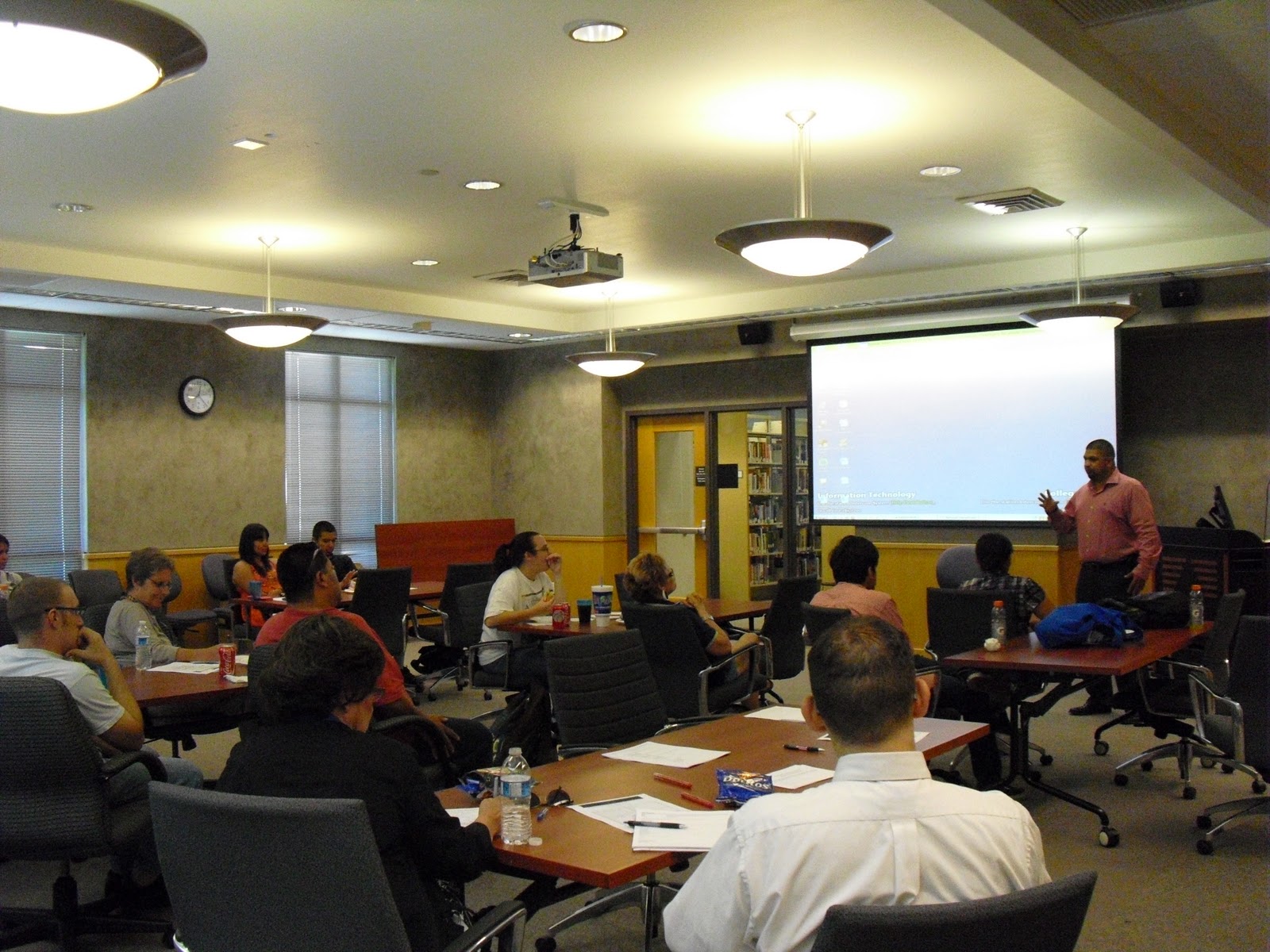
On October 5th the last Hispanic STEM Career Forum on Science was held and fourteen students attended.
Our first guest speaker was Elena Ortiz, Ph. D who is a full-time residential faculty member in the Biosciences Department here at Phoenix College. Elena spoke of her career as an environmental biologist. Her interest came about from hearing the sounds of birds in her native Puerto Rico. She mentioned that one of the benefits of her career is that you get to travel around the world performing various experiments and she even taught a class in Spanish. Students were very interested as she discussed various ways of taking care of the environment and other aspects of biology.
Our second guest speaker was Executive Officer Commander Alex Ortiz from the U.S. Navy. Commander Alex began his career as a Nuclear Engineer with the Navy. He said that he could retire and live well however he loves what he does that he would like to continue performing it. A student asked him how is one of his everyday work schedules like and he responded that when he was in service he had to be on base and quickly perform the duties that were assigned, but now he teaches. Through experience you go up the ranks and have more benefits. Therefore, he recommended the students to pursue higher education as with more education, comes more knowledge and a higher pay. To learn more on what he does as a Nuclear Engineer Power School Instructor, visit: http://www.navy.com/careers/nuclear-energy/nuclear-power-school.html
Lieutenant Matthew Reza is in the Navy Medical Officer Programs and he completed his nursing degree within the Navy. He is very thankful for all the support he has received from the Navy and is continuing his education as a DNP (Doctor of Nursing Practice) which is the new doctorate program in nursing as the masters will no longer be available. He emphasized that the Navy has many programs students can benefit from as they will pay for your education and the reason is due to the need to have more STEM professionals. To learn more about the various careers within the Navy, visit: http://www.navy.com/careers/
The USB winner: Edgar Villarreal
The school suppply backpack winner: Julie Sisley
"I attended a seminar orchestrated by Title V Stem program I won a backpack! To most students a backpack is a nice gift, but for me is meant so much more. This bag having 2 big compartment allows me now to separate my math class work from my biology work. I am now able to keep things organized in my bag so it helps me use my time more wisely. " Julie Sisley
Thursday, November 3, 2011
Hispanic STEM Career Forum - Technology
On September 29, 2011, the STEM Scholars Program had its third Hispanic STEM Career Forum on Technology.
It all began with a presentation on new technology. A list of some technical careers was also presented followed by an explanation of the new technology that is being developed. For example Castlight compares prices of various medical services at different locations. The demand for transparency as consumers have to take on their own medical costs has brought about the creation of Castlight, which also rates the physicians and hospitals. This technology prompted a conversation between two of our active STEM Scholars who are in fields health related fields to discuss the benefits Castlight can bring about. The conversation allowed the opportunity to inform the students on the Health Informatics Technology field as it is an example of how health care and technology knowledge is combined to create a different needed career. By 2014 all the health care documentation has to be transferred to an electronic environment. The increase of health IT within the health care industry will improve the quality of health care, prevent medical errors, reduce health care costs, increase administrative efficiencies, decrease paperwork, and expand access to affordable health care. Information on this and other fields within the technology branch was provided for the students.
The presentation was concluded with the statement that technology is advancing and there is a need to keep up the technological advances. However, technology may fail and that is where we come in to fix the trouble shoots, which is task that our guest speaker confronts with every day. Javier Rodriguez is the Technical Supervisor for the Communication System Support for the Salt River Project (SRP). He began his speech asking the audience to provide him with some information about them such as: name, major, how technology plays a role in their major, and type of phone they use to communicate. As the Technical Supervisor for the Communication System Support for the SRP, his focus is in the way individuals communicate. As the older generation is oppose to technology and the younger generation is adapting to new gadgets. He mentioned that the technology that was presented in the presentation was more of an information base technology while the technology he works with every day is more an operational network. SRP is working on getting rid of the desk phones and integrating all modes of communication to one system. This will localize any individual no matter where he/she is located and through whatever mode of communication system he/she uses.
Javier began his career in the marines. After, completing his service with the marines he worked for a small company that was contracted by SRP. However, SRP offered him a full time position in the Communication System Support department. As the Technical Supervisor he allows his team to be able to make decisions because the work has to be completed. Javier also mentioned a phrase that stood in my mind: “it is what you can do, not the paper (degree).” Yes, students strive to complete their degree, but it is what you are going to do at work that matters. The action matters more than the theory and that is why he enjoys his work, he gets to solve problems every day. It keeps it interesting. Javier is also pursuing his masters in Technology Management at Arizona State University at the Polytechnic campus.
When asked, what types of careers provide job security, Javier mentioned: Information Technology (IT), Engineering, and Environmental Specialist. Technology is advancing, we need to come up with new solutions to solve our every day problems and we need to take care of our environment. That is why those three careers were mentioned as the jobs with more demand and future. Javier was also asked how he keeps his busy lifestyle balanced with work, school and life. He responded: time management is the key as the task change daily and delegating work. He expects his team to be better than he is at decision making. This makes realize that the work is getting done and it is taken care off. Using different learning techniques to realize when and how do you work best. For him, he performs better under pressure that is why he holds the position he has at SRP. It is all about knowing yourself and what works for you. It is also important to take time for yourself. Do an activity that you enjoy doing every day. As for the soft skills that he sees are important, he mentioned: being comfortable with self, being assertive, and taking risks. As a final question Javier was asked: how is technology going to help us to get to a virtualized, more technical world where we can minimize our foot print? Javier answered: “You! Driven individuals like you.”
It all began with a presentation on new technology. A list of some technical careers was also presented followed by an explanation of the new technology that is being developed. For example Castlight compares prices of various medical services at different locations. The demand for transparency as consumers have to take on their own medical costs has brought about the creation of Castlight, which also rates the physicians and hospitals. This technology prompted a conversation between two of our active STEM Scholars who are in fields health related fields to discuss the benefits Castlight can bring about. The conversation allowed the opportunity to inform the students on the Health Informatics Technology field as it is an example of how health care and technology knowledge is combined to create a different needed career. By 2014 all the health care documentation has to be transferred to an electronic environment. The increase of health IT within the health care industry will improve the quality of health care, prevent medical errors, reduce health care costs, increase administrative efficiencies, decrease paperwork, and expand access to affordable health care. Information on this and other fields within the technology branch was provided for the students.
The presentation was concluded with the statement that technology is advancing and there is a need to keep up the technological advances. However, technology may fail and that is where we come in to fix the trouble shoots, which is task that our guest speaker confronts with every day. Javier Rodriguez is the Technical Supervisor for the Communication System Support for the Salt River Project (SRP). He began his speech asking the audience to provide him with some information about them such as: name, major, how technology plays a role in their major, and type of phone they use to communicate. As the Technical Supervisor for the Communication System Support for the SRP, his focus is in the way individuals communicate. As the older generation is oppose to technology and the younger generation is adapting to new gadgets. He mentioned that the technology that was presented in the presentation was more of an information base technology while the technology he works with every day is more an operational network. SRP is working on getting rid of the desk phones and integrating all modes of communication to one system. This will localize any individual no matter where he/she is located and through whatever mode of communication system he/she uses.
Javier began his career in the marines. After, completing his service with the marines he worked for a small company that was contracted by SRP. However, SRP offered him a full time position in the Communication System Support department. As the Technical Supervisor he allows his team to be able to make decisions because the work has to be completed. Javier also mentioned a phrase that stood in my mind: “it is what you can do, not the paper (degree).” Yes, students strive to complete their degree, but it is what you are going to do at work that matters. The action matters more than the theory and that is why he enjoys his work, he gets to solve problems every day. It keeps it interesting. Javier is also pursuing his masters in Technology Management at Arizona State University at the Polytechnic campus.
When asked, what types of careers provide job security, Javier mentioned: Information Technology (IT), Engineering, and Environmental Specialist. Technology is advancing, we need to come up with new solutions to solve our every day problems and we need to take care of our environment. That is why those three careers were mentioned as the jobs with more demand and future. Javier was also asked how he keeps his busy lifestyle balanced with work, school and life. He responded: time management is the key as the task change daily and delegating work. He expects his team to be better than he is at decision making. This makes realize that the work is getting done and it is taken care off. Using different learning techniques to realize when and how do you work best. For him, he performs better under pressure that is why he holds the position he has at SRP. It is all about knowing yourself and what works for you. It is also important to take time for yourself. Do an activity that you enjoy doing every day. As for the soft skills that he sees are important, he mentioned: being comfortable with self, being assertive, and taking risks. As a final question Javier was asked: how is technology going to help us to get to a virtualized, more technical world where we can minimize our foot print? Javier answered: “You! Driven individuals like you.”
Hispanic STEM Career Forum - Math
The second Hispanic STEM Career Forum was held on Wednesday September 21, 2011 at the Campus Vista Conference Room.
Our first guest speaker was Crispin Zamudio who grew up as a farm worker. He started his speech asking the audience: “how many of you know what a farm worker does?” Not many raised their hands. That is because sadly the work of a farm worker is not as recognized. Seeing the few raised hands brought me a feeling of sadness as I value the work of the farm workers, since my family members have also worked in the fields. Therefore, I have a huge respect for their hard work and know of the harsh conditions they undergo to obtain a few cents just so their family will have a better future. That is why I esteem that Crispin even shared that personal side of his story. Being a “campesino” (farm worker) at the age of 4 years old until he was a teenager is part of his roots and is also the motivation to aspire for something greater. Most of our successful Hispanic professionals have their foundations in the “campos” (farms). They experience the harsh conditions and the difficulties that they decided to aim higher. I see them as seeds that once they were placed in good soil with support, they grew and succeeded to inspire others. Crispin was also involved in sports; he won a couple of awards playing basketball for his Kofa High School in Yuma, Arizona. His determination and discipline is what he said are some of the characteristics that have aided him to succeed.
While in high school he attended the Joaquin Bustoz Math and Science Honors Program (MSHP) where he took math university level courses at Arizona State University (ASU). Being part of the MSHP program was instrumental in his success throughout his educational career as Dr. Joaquin Bustoz (the founder of the MSHP program) became his mentor and supported him. It is through individuals who believed in him like Dr. Bustoz and his elementary teachers who encouraged him to pursue a math career that he completed his math degree. Crispin obtained his Bachelors in Arts (B.A.) in Mathematics from the Arizona State University. Then he went on to obtain his Master’s in Education Leadership from the Northern Arizona State University. He is now the director of the e-Institute Charter Schools where he supervises six charter schools. Crispin advises his one-hundred and plus students to “network because it is not what you know, but who you know”. This was the response he gave when he was questioned “What do you know now that would have been helpful to know when you were starting out in your career?” Crispin said: “if by the end of the forum you have not obtained a business card from me, you are at a disadvantage” because you are one person short from reaching your goal. It is so true, so the next time you go to a meeting do not forget to obtain the business card of the individuals you meet and organize them in a business card folder. Network, network, network! It is important and that is why we have provided these series of Hispanic STEM Career Forums. There are three other forums underway, do not lose your opportunity to meet outstanding individuals who are willing to extend a hand to you and support your dream.
Our second guest speaker was Cindy Barragan who shared her story of how she found her way through college. She also started in the Math and Science Honors Program (MSHP) as Crispin. Crispin was actually a counselor when she was in the program and Cindy was my counselor when I was in the program. The three of us are alumnus of the exceptional MSHP program, as it is a support group of like-minded individuals who are pursuing a math or science bachelor’s degree, similar to the STEM Scholars Program. As Cindy said it is through having a support network, such as colleagues or a program that you can succeed. I truly agree with Cindy, so “collaborate to graduate” with your colleagues and get connected to a program such as the STEM Scholars Program. Cindy started with the MSHP program taking Pre-Calculus and tried to associate with students in higher math course levels. However, she noticed the distinction between students who are in different math levels. The calculus students don’t usually associate with pre-calculus students. Another barrier she confronted was having one of her professors tell her that there was no future for her in astronomy. This was a big shock for Cindy as she had always wanted to become an astronomer since she was little kid. It set her back as she had to start her career discovery again. Therefore, she decided to take on an internship with NASA and through her experience decided that astronomy was not what she wanted to do. It was through her own decision of not pursuing astronomy and not her professor’s opinion that she decided to cancel the whole astronomy career. Then when it came time to declare her major, she noticed that she had enough credits toward a math major, so she decided to complete her math bachelors.
After completing her Bachelors in math, she went on to complete her master’s in education and is now teaching at the community college while she is the Senior Coordinator for the Joaquin Bustoz Math and Science Honors Program. In her classes at South Mountain Community College she encourages her students to work in teams as she also values the importance of networking. It is important to collaborate with your classmates as you may never know when you may need of their assistance to obtain the notes you missed in class. Cindy also emphasized that through her college courses she felt singled out as she was the only female and minority student in her courses. However, she did not let that intimidate her and she took control of her career choice.
The third guest speaker was Cleopatria Martinez who is a math faculty here at Phoenix College. She shared a few sections of her life story, which is depicted in the book she wrote along with nine other PhD level Chicana professionals. Cleopatria mentioned that her mother was a single mother who worked really hard to get her through her career. She is very thankful to her mother as she showed her that there is no difference between a man’s and woman’s work for her mother performed both roles. Throughout Cleopatria’s schooling she noticed much of the culture differences, but she did not let that be a barrier in her success as she is very proud of her culture. Something I got from Cleopatria’s speech is “do not let anybody put you down.” We all do great things and in all we do we must strive to do our best work. You can check out the book by the title of “Paths to Discovery” here at the Phoenix College Fannin Library to read more on Cleopatria Martinez’s life story, which is very inspiring!
In all, the three guest speakers were complimentary of each other and each one of them supported the other. Crispin Zamudio opened up the forum very well and reinforced the importance of networking and even provided the students with his business card. Therefore, network for you never know which card you will need to play. Cindy’s story, left me the message that you decide your future, don’t let anyone dictate to you can or cannot do. The future is in your hands. Cleopatria Martinez supported this idea with “do not let anybody put you down.” Be proud of who you are and who you represent. To learn more on Cleopatria's Martinez story read the book Paths to Discovery: http://www.chicano.ucla.edu/press/paths.asp
The Phoenix College Faninn Library has four copies you can check out under the following Call #: Q141 .P3746 2008
Our first guest speaker was Crispin Zamudio who grew up as a farm worker. He started his speech asking the audience: “how many of you know what a farm worker does?” Not many raised their hands. That is because sadly the work of a farm worker is not as recognized. Seeing the few raised hands brought me a feeling of sadness as I value the work of the farm workers, since my family members have also worked in the fields. Therefore, I have a huge respect for their hard work and know of the harsh conditions they undergo to obtain a few cents just so their family will have a better future. That is why I esteem that Crispin even shared that personal side of his story. Being a “campesino” (farm worker) at the age of 4 years old until he was a teenager is part of his roots and is also the motivation to aspire for something greater. Most of our successful Hispanic professionals have their foundations in the “campos” (farms). They experience the harsh conditions and the difficulties that they decided to aim higher. I see them as seeds that once they were placed in good soil with support, they grew and succeeded to inspire others. Crispin was also involved in sports; he won a couple of awards playing basketball for his Kofa High School in Yuma, Arizona. His determination and discipline is what he said are some of the characteristics that have aided him to succeed.
While in high school he attended the Joaquin Bustoz Math and Science Honors Program (MSHP) where he took math university level courses at Arizona State University (ASU). Being part of the MSHP program was instrumental in his success throughout his educational career as Dr. Joaquin Bustoz (the founder of the MSHP program) became his mentor and supported him. It is through individuals who believed in him like Dr. Bustoz and his elementary teachers who encouraged him to pursue a math career that he completed his math degree. Crispin obtained his Bachelors in Arts (B.A.) in Mathematics from the Arizona State University. Then he went on to obtain his Master’s in Education Leadership from the Northern Arizona State University. He is now the director of the e-Institute Charter Schools where he supervises six charter schools. Crispin advises his one-hundred and plus students to “network because it is not what you know, but who you know”. This was the response he gave when he was questioned “What do you know now that would have been helpful to know when you were starting out in your career?” Crispin said: “if by the end of the forum you have not obtained a business card from me, you are at a disadvantage” because you are one person short from reaching your goal. It is so true, so the next time you go to a meeting do not forget to obtain the business card of the individuals you meet and organize them in a business card folder. Network, network, network! It is important and that is why we have provided these series of Hispanic STEM Career Forums. There are three other forums underway, do not lose your opportunity to meet outstanding individuals who are willing to extend a hand to you and support your dream.
Our second guest speaker was Cindy Barragan who shared her story of how she found her way through college. She also started in the Math and Science Honors Program (MSHP) as Crispin. Crispin was actually a counselor when she was in the program and Cindy was my counselor when I was in the program. The three of us are alumnus of the exceptional MSHP program, as it is a support group of like-minded individuals who are pursuing a math or science bachelor’s degree, similar to the STEM Scholars Program. As Cindy said it is through having a support network, such as colleagues or a program that you can succeed. I truly agree with Cindy, so “collaborate to graduate” with your colleagues and get connected to a program such as the STEM Scholars Program. Cindy started with the MSHP program taking Pre-Calculus and tried to associate with students in higher math course levels. However, she noticed the distinction between students who are in different math levels. The calculus students don’t usually associate with pre-calculus students. Another barrier she confronted was having one of her professors tell her that there was no future for her in astronomy. This was a big shock for Cindy as she had always wanted to become an astronomer since she was little kid. It set her back as she had to start her career discovery again. Therefore, she decided to take on an internship with NASA and through her experience decided that astronomy was not what she wanted to do. It was through her own decision of not pursuing astronomy and not her professor’s opinion that she decided to cancel the whole astronomy career. Then when it came time to declare her major, she noticed that she had enough credits toward a math major, so she decided to complete her math bachelors.
After completing her Bachelors in math, she went on to complete her master’s in education and is now teaching at the community college while she is the Senior Coordinator for the Joaquin Bustoz Math and Science Honors Program. In her classes at South Mountain Community College she encourages her students to work in teams as she also values the importance of networking. It is important to collaborate with your classmates as you may never know when you may need of their assistance to obtain the notes you missed in class. Cindy also emphasized that through her college courses she felt singled out as she was the only female and minority student in her courses. However, she did not let that intimidate her and she took control of her career choice.
The third guest speaker was Cleopatria Martinez who is a math faculty here at Phoenix College. She shared a few sections of her life story, which is depicted in the book she wrote along with nine other PhD level Chicana professionals. Cleopatria mentioned that her mother was a single mother who worked really hard to get her through her career. She is very thankful to her mother as she showed her that there is no difference between a man’s and woman’s work for her mother performed both roles. Throughout Cleopatria’s schooling she noticed much of the culture differences, but she did not let that be a barrier in her success as she is very proud of her culture. Something I got from Cleopatria’s speech is “do not let anybody put you down.” We all do great things and in all we do we must strive to do our best work. You can check out the book by the title of “Paths to Discovery” here at the Phoenix College Fannin Library to read more on Cleopatria Martinez’s life story, which is very inspiring!
In all, the three guest speakers were complimentary of each other and each one of them supported the other. Crispin Zamudio opened up the forum very well and reinforced the importance of networking and even provided the students with his business card. Therefore, network for you never know which card you will need to play. Cindy’s story, left me the message that you decide your future, don’t let anyone dictate to you can or cannot do. The future is in your hands. Cleopatria Martinez supported this idea with “do not let anybody put you down.” Be proud of who you are and who you represent. To learn more on Cleopatria's Martinez story read the book Paths to Discovery: http://www.chicano.ucla.edu/press/paths.asp
The Phoenix College Faninn Library has four copies you can check out under the following Call #: Q141 .P3746 2008
Hispanic STEM Career Forums - Engineering
On Thursday September 15, 2011 the STEM Scholars Program had its first Hispanic STEM Career Forum and the concentration was on engineering careers. We had two guest speakers.
Our first guest speaker was Monique de los Rios from Lima, Peru. Monique works for Maricopa Association of Governments (MAG) as an arquitect. She started her presentation informing us that her father was an arquitect and that there are eight arquitects in her family including two of her nieces. Therefore, as she said “arquitecture runs in our blood.” Her passion toward arquitecture started when she observed that her dad enjoyed working on his projects on the drafting table. Monique said, “arquitecture demands a lot from you and your work is always criticized. Therefore you have to have the commitment towards arquitecture and have a thick skin towards the harsh criticism you might get.” However, creating something new that did not exist is so rewarding and your work gets recognized.
There are various academic pathways that can be taken to complete your profession in arquitecture. The general route is: begin with an associate in design, then go for a bachelor’s of Science in arquitecture and obtain your license to practice. The other pathways are: four years of education and then take an exam, or five years of education and an exam, or four years of a bachelor’s education and two years towards a master. Hoewever, there is a year of internship experience and an exam to complete.
Arquitecture is the center for many other careers in design, such as: interior design, acoustic design, urban design and many others. In today’s society esthetics are becoming important as it is the first thing the eye sees. Arquitecture is another profession that gets impact when the economy is not doing too well. A question was asked on how globalization affects the arquitecture career, to which Monique responded that there is a correlation and she commented that when she was, studying arquitecture all her books were in other languages. So there is a globalization relationship with arquitecture. However, the sky is the limit.
When Monique was asked about what skills are required for an arquitect she replied: good communication skills, computer savy, 3D visualization, calculating your structures (such as number of steel needed), arithmetic, and some physics. Communication is becoming a skill that is required in various careers, but specially in arquitecture as you have to sell your product to your client. The demand to be computer savy is important as technology advances so much. Now, arquitects can build the building as a real computer model and then build the actual structure.
Monique is very interested in solar energy and ecology. Therefore, Paolo Soleri, an Italian arquitect has been her role model and her inspiration. She concluded her presentation with a youtube video under the name of “urbanlabrat” (http://www.youtube.com/watch?v=0iRd41gvhaw), which shows Paolo Soleri’s project by the name of Arcosanti (a combination of arquitecture and ecology: http://www.arcosanti.org). His idea for his project is to create a city where everyone lives toghether and in peace. Paolo’s project is being constructed through the profits from the sales of his famous soleri bells.
Hilen Cruz was our second guest speaker and she is a Civil Engineer for SRP (Salt River Project). Her initial studies were completed in Mexico and then she came to the United States to complete her MBA (Masters in Business Administration). Hilen’s dad is also a Civil Engineer and it is her role model. It is through his teaching that she decided to pursue a Civil Engineering degree. When she came to Phoenix, Arizona she was working for a small company where she was doing work for SRP. After she was complete her work with the small firm, SRP offered her a job as an Electrical Engineer and she took it as she was familiarize with the responsibilities. She is now works as the Policy, Procedure & Standards for SRP. Her bilingual skills are beneficial for her, since it will provide her the opportunity to travel for business purposes. When asked for the important qualifications to possess she answered: determination, good habits, organization skills, and good communications skills. Education offers you the opportunity to grow. That is why she decided to come back to school and study real estate for her own benefit. Hilen is involved in a community organization within SRP called WIN (Women In Network) which conduct various community service events to help women. Hilen has also written a book by the name of “Ponte las Pilas, Mexico” (Put On the Batteries Mexico) , which “is an inspirational book that aims to motivate the Mexican community to pursue professional success thru higher education.” You can read more on her book through her website: http://www.pontelaspilasmexico.com/
Subscribe to:
Posts (Atom)